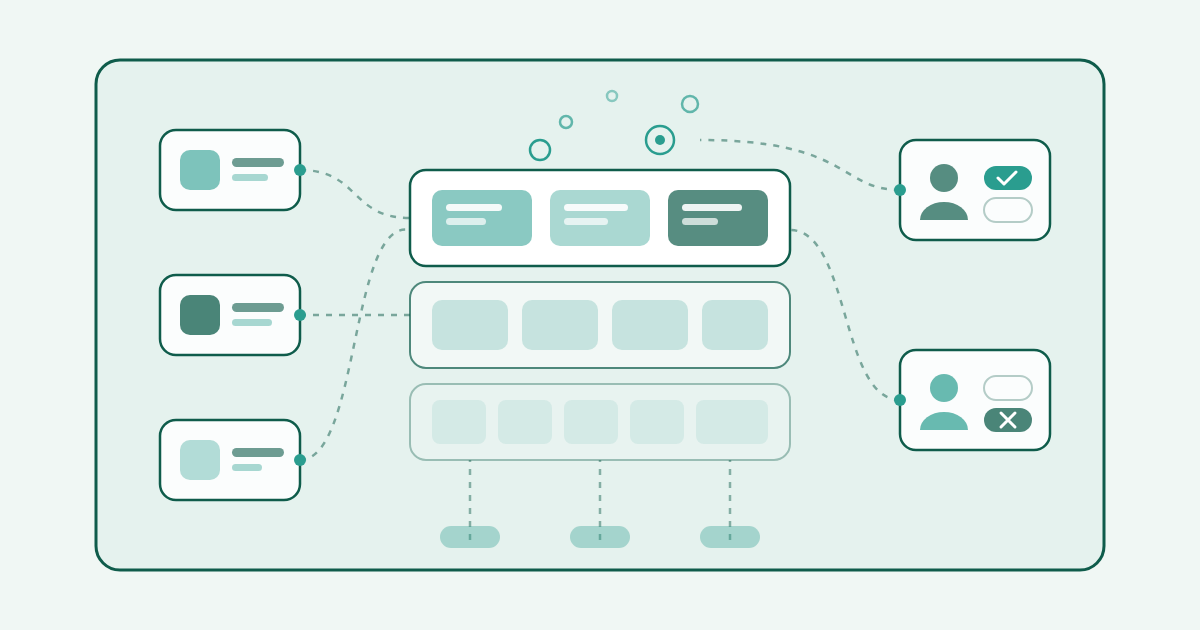
There's a lot of noise and chatter around this notion of a second brain. It still stems from this personal second brain, the Obsidian kind of thing that was happening maybe eight to ten months ago. On the other side, there's a lot of theoretical, almost academic researchy stuff that doesn't point us in any direction. This is not a novel idea. People are talking about it.
What I've seen online makes me skeptical. People just talk about it as storage. They're not talking about the system that the second brain is. What I see is not opinionated enough about how this system should work.
But the architectural pattern is too logical to dismiss. We have these surface agents on the edge that are doing work, and we need a way for them to share context. Having a common resource in the middle is the obvious answer.
Why a central resource
The other patterns don't get you there. It can be point-to-point on demand. When agent one is touching some part of an application, it can reach out to agent two and say, hey, what do I need to know here? That doesn't feel very efficient. It could be more like a chain, a running record of what has happened, essentially GitHub in a way. Neither of these allows for curation. So it's too logical for there not to be a central resource. Whether that's a brain or something else, I don't know.
From an infrastructure perspective, the architecture is solved. Having a place that is accessible by many, to dump markdown files and give them some sort of structure, is the right starting point. You can see that in the Notion rollout of their new platform. Memories on qbash, which Tasks and connectors can write into, are that kind of shared place. If you just have a place where you are dumping everything, that is not going to be useful for very long. You need a system of curation.
The curation process over the brain
People already have storage and recall. They can layer a vector database on top, or connect memories as nodes through artifacts and edges. What's missing is the system over that store. There is some sort of processing, more akin to a software application, constantly curating and making this thing useful and usable, not letting it spiral out of control. It's maybe moving things from hot storage to cold storage. There's some finite amount of things that can be held in context memory without having to dig deeper, much like a human brain.
As these agents are working, that process consolidates, prunes, prioritizes, and gives shape to the knowledge layer, including what's at the surface and what's stored a little deeper. This is changing over time, but LLMs will still notoriously prioritize things earlier in the instructions over things later. So how do you accommodate some of the quirks of models, and design context so that it is somewhat prioritized?
There's also the way that subject matter experts interact with that same layer. People can already go in and edit docs and create docs. I don't think that the interface of the future is writing markdown docs. Bubbling up is the visual that keeps coming to mind, something a little more dynamic than that.
Builders and subject matter experts
Who is it shared between? It's me, my agents, my team, everyone together. Where people are focusing right now is agents. How are context and memory and brain shared across agents? That's the coal face for these kinds of systems. But it is only logical or natural for this to also be the interface for people. In the end there are only two roles: builders, people assembling and deploying agents, and subject matter experts. The subject matter expert's role is to interact with the knowledge layer, to make sure that it is always correct in its memory and in the context that it lays out, agnostic of what the agents are working on. The agents use that memory when they come to whatever it is they need to be doing. The interface of the future is the memory layer.
I think about my time at Nasdaq a lot. The head of the equities data product team has a huge amount of subject matter expertise around the SIP, the consolidated feed of US stock quotes and trades, around FINRA and SEC regulations, around what customers really want. They're talking to a lot of customers and understanding their pain points. They understand the way that regulation is moving. They might understand how the opening cross works and how different exchanges run their auctions. There is this technical and subject matter knowledge, and the new way that they synthesize it into product is just by curating and maintaining the context in the layer.
Connected to your other systems
This second brain should also be connected to your other systems. It is the same brain that has your data inputs and outputs, your CRM, your this, your that. There are systems hydrating this knowledge layer, and the bubbling up has to come from that. In the Nasdaq case, you have all of the SIP data firing into it, and a stream of regulatory data filing into it. I imagine that one of the functions of the system that lies over this is almost like idea generation. It's looking at all of this incoming data and going, that's interesting. There is probably this regulatory change coming down the pipe that impacts these products that we have. A part of the subject matter expert's role is to look at the bubbles as they come up and say, yes, that is valid. No, that is not valid and here is why. Thumbs up, thumbs down, reinforce the learning.
If the theory I'm laying out is right, that the work interface of the future is the knowledge layer and at least 50% of your organization is curating context, then there would need to be some sort of observability of what the system is bubbling up as context. New dedicated roles will come out of this, people responsible for the system, or for different parts of it. They're probably builders.
What would convince me it works
I'm not sure. I don't think that it's mature enough yet, or that we understand enough of what it is that we're setting out to do. What would convince me is a feeling thing. You'd want to see that whatever system ends up being in place is bubbling the right context and information on top, and that these agents are making the right decisions, most if not all of the time.
At some point the lines do blur between a knowledge base as an architected storage thing and training your own models based on your data and your expertise. I'm leaving that to the side for now.