As somebody who has been building software with Isle of Code since 2012 it's difficult to explain the breakneck speed of AI evolution, especially over the last 12 months. I shared a strategy deck with our customers in October and this was one of the key points. Today I want to expand on just how quickly AI and adjacent capabilities continue to evolve.
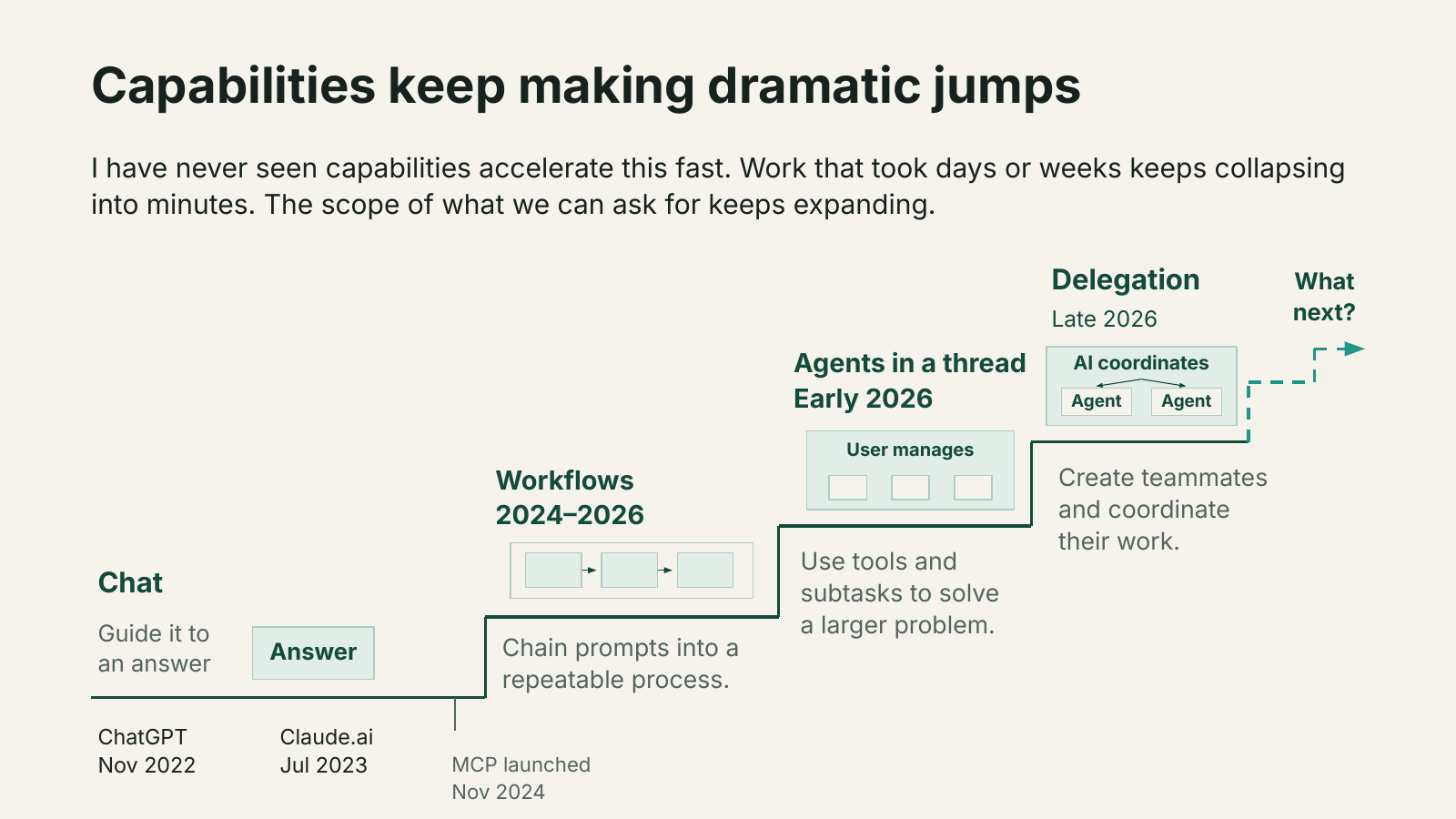
Chat is the easiest point to trace the current boom from and start our journey. Usage of AI was largely single shot and limited in scope: ask a question, get an answer and leave. Models at the time were capable but also failed to count the r's in strawberry. There was a skill required to use chat and you would pick different models for different tasks (remember when that was important?). AI was still useful though and you knew something was there.
Prompting was the first big step up. Prompting let people create repeat instructions - be that a set of steps to process or even a guide. One of my most useful early prompts was "Explain this .NET concept to me as somebody coming from Rails/Phoenix", which turned out to be extremely useful on some legacy projects we were picking up. Well-built prompts turned one-off answers into semi-reliable repeat operations and also gave us a way to share them with other team members. Sometimes that sharing was as simple as copy-pasting from a Google Doc.
As an aside, my mental model of a good prompt has always been an "AI function" where the same rules apply - single purpose, testable. This had a huge influence over my views on AI.
With prompting figured out workflows came next. AI would routinely fail when trying to work through more than one problem or a multi-faceted problem - but you could work around that by chaining several prompts together to produce an answer. This only worked for deterministic processes but let us accelerate the level of automation once more.
Next came one of the biggest jumps - agents. A single chat session could launch fresh subtasks - blank chats - to break work down and only receive the answer. As a result AI could take on a larger task and start automating work that was less defined. As somebody who has been running an AI native company through this evolution, agents felt like the biggest jump. We watched non-technical customers suddenly architecting answers to problems they had not thought possible before.
We are now in the midst of another jump - delegation. Delegation means AI can run a piece of work the way a manager would, splitting it up, handing it out and checking what comes back. "Design an ad for this keyword" is a task. "Develop and monitor our campaigns" is a whole function, and AI can now run it. Dell described this on their earnings call this week as AI moving from a tool and an adviser to an operator. This really unlocks a lot, as AI has moved another layer up the stack.
If you remember that famous "Software is eating the world" essay - well, AI just keeps eating the next layer. And again, it is worth reflecting on just how quickly all of this has happened. Each jump changed what we could automate and the next one arrived before most companies had caught up with the last.
Depth and breadth are driving this evolution
Two things are driving this and both are increasing at once - depth (more capable models) and breadth (the work that can be orchestrated). My finding is most people have their minds latched on depth and the feeling of more capable models. The breadth of work AI can orchestrate is largely ignored and it is the part that should be worrying most services companies. We see it in our own work - Alex MacLeod wrote up how we automate our demo video production, where a Claude Code skill writes the script, drives the app in a browser, films it and cuts the edit. That is a whole function, and the kind of work a services company sells. Jeff Clarke put it well on the same Dell call: "Work is really 3 components. There's a component of work that you define what it is, you actually do it and you verify it. The action, the operating of the work is being increasingly moved towards agentic."
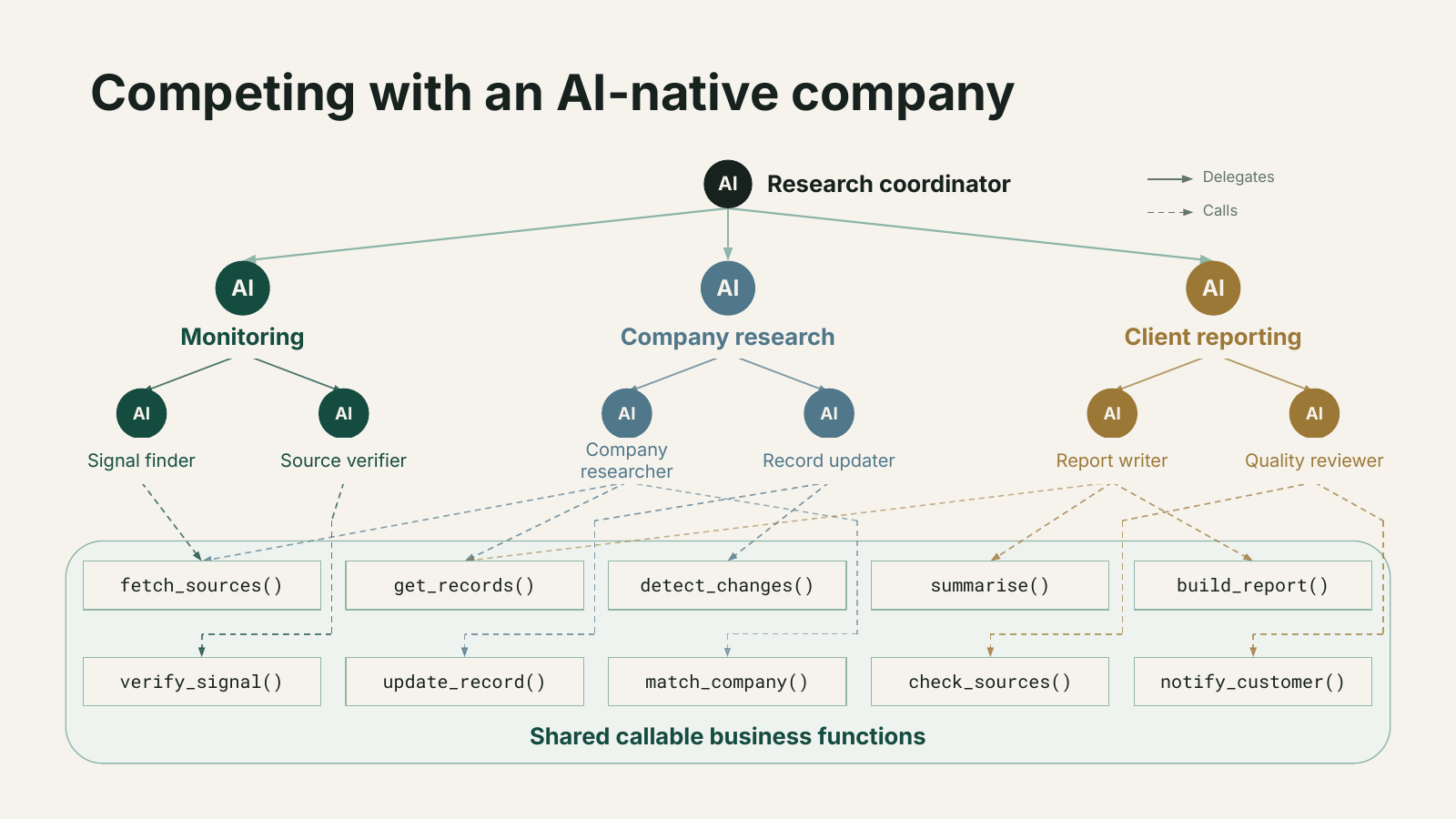
This fast evolution adds a tough dynamic to companies lagging in adoption. In the chat era there was an easy on-ramp and you would learn as you go. Now systems are running systems and elementary AI skills are required but not trained daily in the same way. Knowledge workers who have not adapted their understanding - or even still think in chat terms - are fast approaching touching the keyboard with their pointer finger, one letter at a time.
I was talking with my cofounders about this recently. Smaller companies are ripping out internal tools while larger companies are killing it with process replacements that they can put real resources behind. It is the middle companies struggling the most with adoption and getting compressed from both sides. Adoption of "current gen" AI appears heavily bimodal, with smaller and larger companies pulling ahead.
We went from a chat window that couldn't count the r's in strawberry to AI running whole functions. And the scary part is it happened so fast and we are still early in the evolution.
In the prompting days I used to describe AI to customers as a big bang - and the bang had not happened yet, we were just in the pre-tremors. With delegation it feels like the bang has happened and we are about to really see a full shift in who (or what) does the work.